

What Is a Sales Spiff? The Definition That Actually Matters for Distributors
A Sales Spiff — sometimes written as SPIFF, short for Sales Performance Incentive Fund — is a direct, immediate bonus paid to a salesperson for completing a specific, defined sales action within a set time window. Unlike a commission structure that rewards overall performance across a pay period, a Sales Spiff is surgical. It targets one behavior, one product, one outcome — and rewards it fast.
According to Wikipedia, the term “spiff” dates back to at least 1859, when it described a premium paid to shop assistants for selling old or unfashionable stock. The mechanics haven’t changed much. You identify something you need moved, you attach a reward to moving it, and you give your reps a reason to prioritize it over everything else on the shelf.
In automotive chemical distribution, a Sales Spiff might look like this: $10 per case of a new fuel system cleaner sold to shops during a 30-day product launch window. Or $50 for any account that places their first order of a new brand before the end of the month. Or a tiered payout — $100 for 10 units, $250 for 25 — designed to push volume on a product that’s been sitting in the warehouse too long. The structure varies. The principle doesn’t: a Sales Spiff creates a specific incentive for a specific action in a specific window of time.
Types of Sales Spiffs Distributors Actually Use
Not every program is built the same. Understanding what is a Sales Spiff type that fits your operation is the first step. The structure determines whether reps chase it hard or ignore it. Here are the four types that show up most in automotive chemical distribution.
Manufacturer-Funded
This is the most common type in the channel. A manufacturer puts up the payout budget and defines the qualifying products. Your job is to communicate the program to your reps and make sure payouts flow correctly. The challenge with manufacturer-funded programs is managing multiple campaigns simultaneously across different brands without losing track of what’s owed to whom.
Product Launch
When a manufacturer releases a new SKU, it needs to get into shops fast. A product launch incentive gives your reps a direct financial reason to introduce it on every route call during the launch window. Without one attached, new products tend to sit in the warehouse while reps default to selling what accounts already know.
Volume Threshold
Tiered by design — sell 10 units and earn $50, sell 25 and earn $150, sell 50 and earn $350. This structure works because it creates escalating urgency. Once a rep hits the first tier, the next one is visible and within reach. Volume threshold programs consistently outperform flat-rate ones because they reward reps who push beyond the minimum.
Slow-Moving Inventory
Every distributor has product sitting longer than it should. A targeted Sales Spiff is one of the cleanest ways to move it before it becomes a write-off. Attach a meaningful payout to the slow-moving SKU, run it for 30 days, and let your reps do the work. The cost is almost always less than carrying dead inventory through another quarter. See how a Sales Spiff program works inside Optimum.
Sales Spiff vs. Commission: Why the Distinction Matters
A lot of distributors use the terms interchangeably. They shouldn’t. Commissions and a Sales Spiff serve fundamentally different purposes, and confusing them leads to poorly designed programs that underperform both.
What Commissions Do
A commission is ongoing, percentage-based compensation tied to overall sales performance. It rewards your reps for the totality of what they sell across a pay period. Commissions are your baseline — the engine that keeps your sales team motivated week in, week out. They’re not designed to change behavior in the short term. They’re designed to sustain performance over time.
What a Sales Spiff Does
A Sales Spiff is a spark, not a fuel source. It’s designed to shift behavior quickly — to make a rep choose one product over another, to create urgency around a specific goal, to inject energy into a sales floor that’s settled into routine. A Sales Spiff doesn’t replace commissions. It layers on top of them to produce a specific, time-bound outcome that commissions alone can’t deliver.
The practical difference shows up on the route. Without a Sales Spiff, a rep walks into a shop and sells whatever the account usually buys. With a well-designed Sales Spiff in place, that same rep has a reason to mention the new product, push the promotional item, or ask for the upsell — because there’s a direct, immediate reward attached to it. That’s behavioral shaping, and it’s something commission structures simply aren’t built to do.
“We used to lose thousands every month because our spiff tracking was a mess of manual spreadsheets and unverified claims. Now, every dollar is mapped directly to a cleared invoice.”
Tina R, SW Wynn’s | Office Manager-Owner
Why a Sales Spiff Works Especially Well in Automotive Distribution
Automotive chemical distribution is a business built on relationships and repetition. Your reps visit the same shops, the same quick lubes, the same dealerships week after week. Accounts fall into patterns. They buy what they always buy, in the quantities they always buy, because that’s what works for them. A Sales Spiff is one of the few tools that can break that pattern — legitimately and profitably.
Moving New Product Through the Channel
When a manufacturer launches a new product, getting it into shops is the first battle. A well-structured Sales Spiff gives your reps a concrete reason to introduce it, and gives shop owners a reason to try it. Instead of a passive mention, the product becomes the focus of the visit. A Sales Spiff turns a product launch from a slow burn into a concentrated push — which is exactly what manufacturers need when they’re trying to establish a new SKU in a competitive shelf environment.
Clearing Inventory Before It Becomes a Problem
Every distributor has inventory that’s moving slower than it should. A targeted Sales Spiff is one of the cleanest ways to address it. Attach a meaningful payout to the slow-moving product and watch your reps prioritize it. The alternative — sitting on inventory until it’s a write-off — is far more expensive than the Spiff payout ever would have been. See how Optimum’s distribution management tools help.
Driving Volume at Critical Moments
End of quarter. A manufacturer’s promotional window. A competitive push into a territory where a rival distributor has been gaining ground. These are moments when a Sales Spiff delivers outsized value. Concentrated effort, concentrated reward, concentrated results — within a defined time window that keeps the urgency real.
How to Run a Sales Spiff Program That Actually Pays Off
What is a Sales Spiff program done right? It’s straightforward in theory and surprisingly easy to get wrong in practice. Here is the process that works for route-based distributors running programs across multiple brands and dozens of accounts.
1. Define Exactly What Qualifies
Ambiguity kills programs before they start. Before you announce anything, write down the exact qualifying product, the exact sales action required, the exact timeframe, and the exact payout. If a rep has to ask whether a sale qualifies, the criteria are not clear enough. Every dollar of confusion costs you rep trust and program engagement.
2. Set a Timeframe That Creates Urgency Without Burning Out
Two to four weeks is the sweet spot for most programs in distribution. Long enough for reps to build momentum on their routes, short enough that the deadline feels real. A program that runs for three months stops driving behavior and starts becoming background noise. Keep the window tight and the energy high.
3. Choose a Payout That Actually Motivates
The right payout depends on your margins and your reps. The harder the ask, the higher the reward needs to be. Moving a new product into accounts that have never tried it is harder than upselling an existing one. Price it accordingly. A payout that feels trivial to a rep is a program that does not get worked.
4. Communicate It Before the Window Opens
Your reps should know about the program before it starts, not the morning it launches. Walk them through the qualifying criteria, the payout structure, and where they can track their balance in real time. Reps who understand the program on day one outperform reps who figure it out on day ten every time.
5. Track It in Real Time and Pay It Fast
This is where most distributors leave money on the table. If reps cannot see their balance without calling the office, engagement drops. If payouts take three weeks after the program closes, trust erodes. The fastest way to make your next program more effective than the last one is to pay the current one accurately and on time. Reps remember both.
The Sales Spiff Mistakes That Cost Distributors Real Money
Knowing what is a Sales Spiff is one thing. Running one without these common mistakes is another.
Running a Sales Spiff Too Long or Too Often
A Sales Spiff that never ends stops being a Spiff and starts being a baseline expectation. When reps come to rely on a Sales Spiff as part of their standard compensation, you’ve lost the behavioral leverage that makes it valuable. Industry research reinforces this — overused programs lose their motivational pull and can actually create entitlement rather than urgency. Use a Sales Spiff strategically, not constantly.
Setting Criteria That Nobody Understands
If a rep has to ask three questions to figure out whether they qualified for a payout, the program is already broken. Complexity kills engagement. The criteria need to be immediately obvious: sell this product, hit this number, within this window, earn this reward. Any ambiguity around qualification is a trust problem waiting to happen.
Managing a Sales Spiff on a Spreadsheet
This is where most distributors bleed the most. Running it manually — tracking qualifying sales in a spreadsheet, calculating payouts by hand, reconciling everything at month end — is slow, error-prone, and guaranteed to create disputes. When a rep questions their payout and you can’t show them the data in real time, you don’t just lose the argument. You lose their trust in the program. And a Sales Spiff that reps don’t trust is one that doesn’t work.
How Optimum Makes Managing a Sales Spiff Program Easier
The gap between a Sales Spiff that works and one that drains your budget isn’t usually the design of the program — it’s the execution. Specifically, it’s the tracking. When payout data lives in a spreadsheet, errors are inevitable. When reps can’t see their own balances, engagement drops. When reconciliation happens once a month instead of in real time, disputes pile up and payouts get delayed.
Optimum’s Spiff management tools are built specifically for how automotive chemical distributors actually run their programs. Every qualifying sale is tracked automatically. Reps can see their balances in real time — which means your route runners can walk into an account and show a shop manager exactly what they’ve earned, on the spot, without calling the office. Managers can see program performance across all accounts without waiting for someone to compile a report.
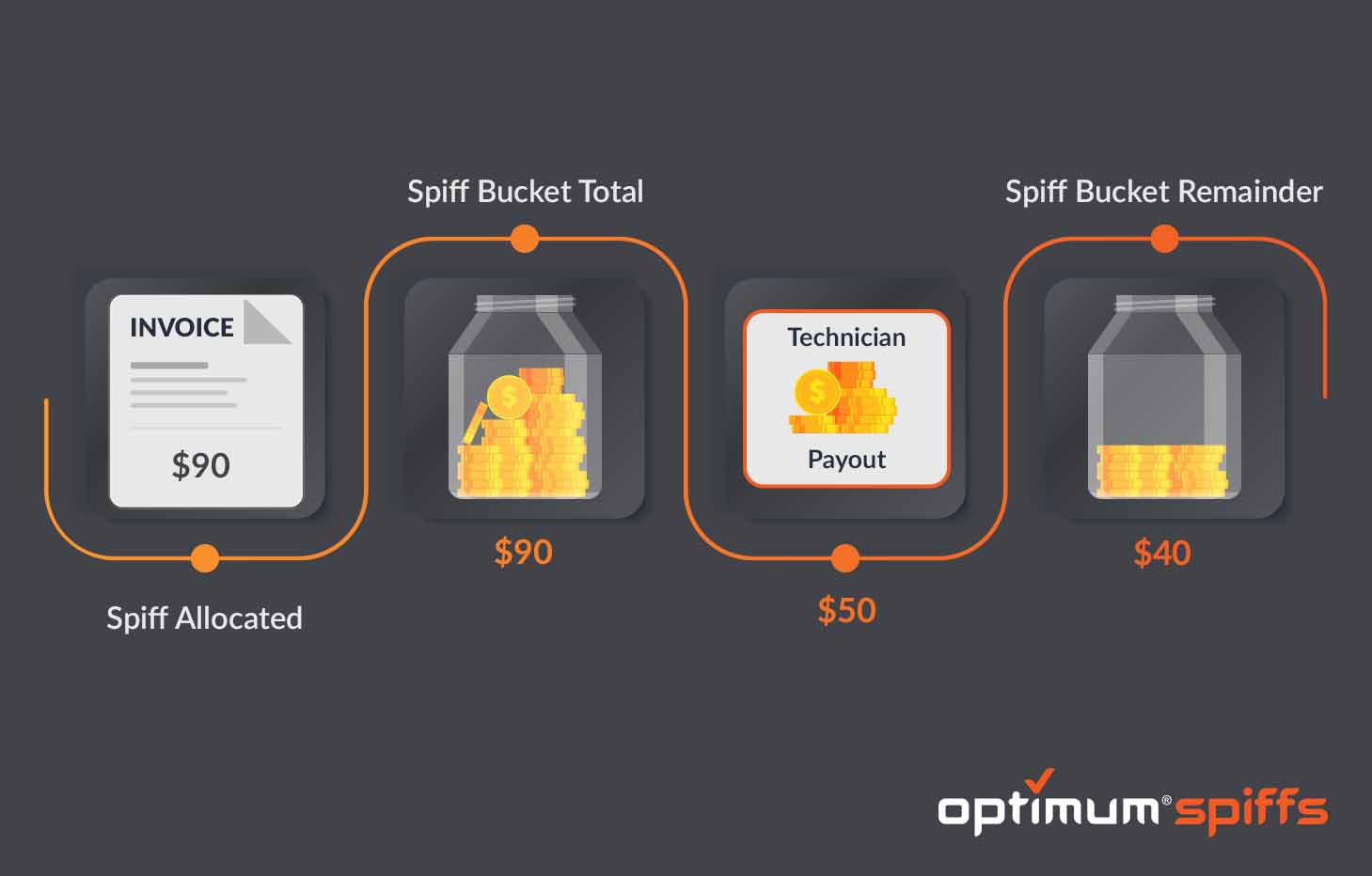
Spiff Bucket Management That Actually Scales
Running a single program is manageable. Running five simultaneous ones across three manufacturer brands, with different tiers and different qualifying products for different account types — that’s where manual management collapses.
Optimum handles multiple concurrent programs without anyone losing track of what’s owed to whom. Every bucket is tracked separately, every payout is calculated automatically, and every account can see their status without a phone call.
From Sales Spiff to QuickBooks Without the Manual Bridge
Every payout that clears flows directly into QuickBooks. No export. No import. No manual entry. Your accounting team sees it the moment it happens — which means month-end closes faster, payout disputes are easier to resolve, and your financials actually reflect what’s happening in the field instead of what someone got around to entering last Tuesday.
Frequently Asked Questions About Sales Spiffs
Here are the most common questions distributors ask about what is a Sales Spiff, how programs are structured, and how to run them without errors.
What does SPIFF stand for?
SPIFF stands for Sales Performance Incentive Fund. You will also see it written as SPIF with one F. Both refer to the same thing. The term dates back to at least the 1800s and the mechanics have not changed much since: attach a reward to a specific sales action and watch reps prioritize it.
What is a Sales Spiff vs. a sales commission?
A sales commission is ongoing, percentage-based compensation tied to everything a rep sells over a pay period. A Sales Spiff is a one-time, targeted bonus tied to a specific product or action within a specific window. Commissions sustain performance over time. A Sales Spiff shifts behavior fast. The two work together — commissions are the engine, a Sales Spiff is the accelerator.
How much should a payout be?
There is no universal number, but in automotive chemical distribution most programs run between $10 and $100 per qualifying sale depending on the product margin and the difficulty of the ask. Manufacturer-funded programs tend to have defined rates. Distributor-funded programs have more flexibility. The right payout is whatever makes a rep choose your target product over the path of least resistance.
How long should the program run?
Two to four weeks for most programs. Long enough for reps to work their full route cycle at least once, short enough that the deadline drives urgency. Programs that run longer than 60 days tend to lose their behavioral impact as reps normalize the extra payout into their baseline expectations.
Can you run multiple programs at the same time?
Yes, and most distributors working with multiple manufacturer brands do exactly that. The challenge is tracking them separately without errors. When you are managing three manufacturer-funded programs simultaneously across 40 accounts, a spreadsheet stops working. The payouts get tangled, reps question their balances, and your ops team spends hours reconciling instead of running the business. This is the specific problem purpose-built distribution software solves.
Are payouts taxable?
Yes. Sales Spiff payments are considered supplemental income and are subject to federal income tax withholding. Reps may need to provide a W-9 depending on how your program is structured. If you are running manufacturer-funded programs, the manufacturer typically handles the tax paperwork directly with your reps. Consult your accountant or tax advisor for guidance specific to your operation.
What is the difference between a Sales Spiff and a rebate?
A Sales Spiff pays the salesperson. A rebate pays the buyer or the distributor. A manufacturer might run both simultaneously — one to motivate your reps to push the product, and a rebate to give the end account a reason to buy it. They target different parts of the channel and can be layered on top of each other effectively.
Now that you know what is a Sales Spiff and how to run one, the last piece is execution. A Sales Spiff is one of the most effective tools in automotive distribution for driving targeted, short-term revenue — when it’s tracked correctly, paid promptly, and managed in a system built for the complexity of running programs across multiple brands and dozens of accounts. If your current process involves spreadsheets and manual reconciliation, you’re doing the hard part twice and still getting results that are slower and less accurate than they should be. That’s the problem Optimum solves. Built for distributors, not for generic sales teams — and ready to make your next program your best one yet.
Watch Your First AI Workflow Come to Life
In this 15 minute 1-on-1 session, we will map out your most frustrating manual process and build a functional AI automation prototype right in front of you.