
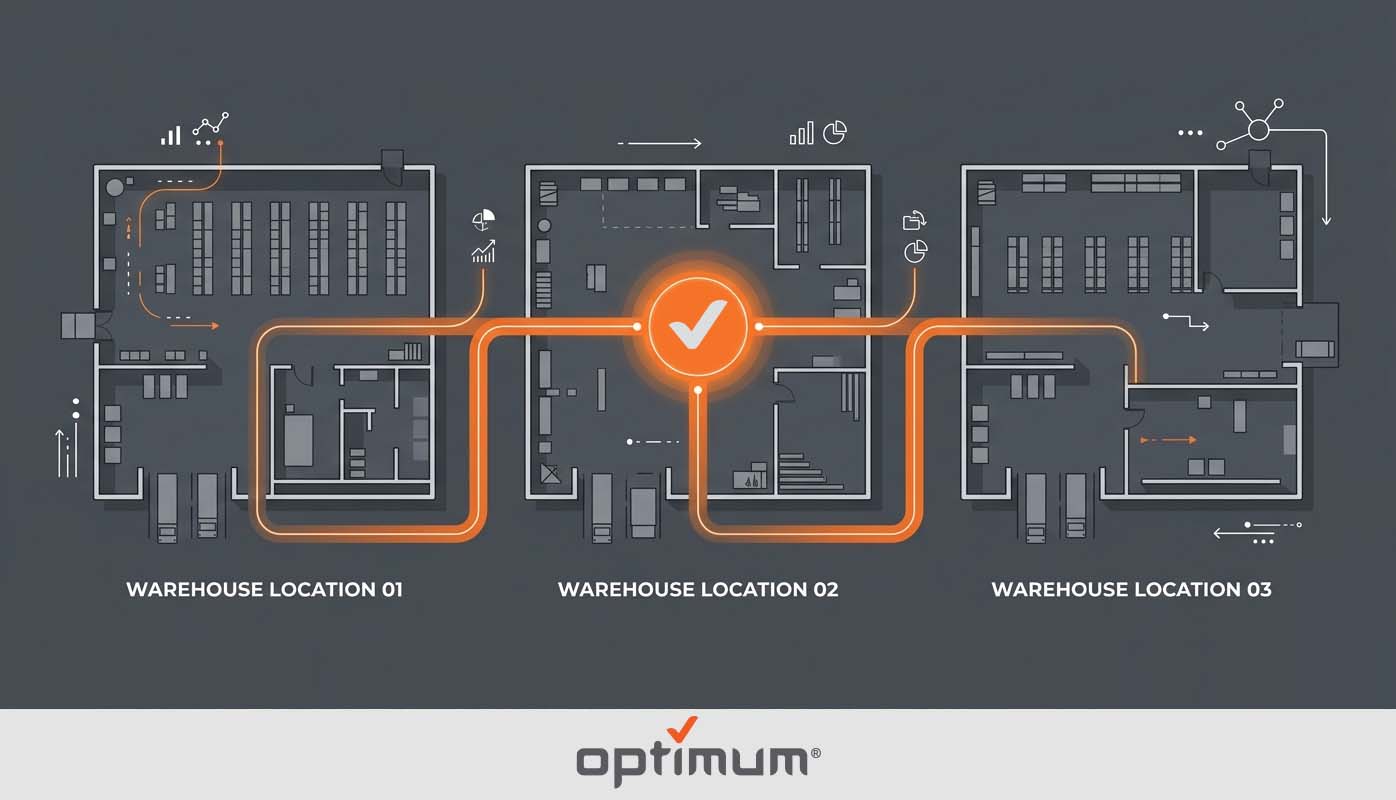
If you’re running distribution out of more than one location, you already know the problem. Stock sitting at one branch while another is backordering the same SKU. Inter-branch transfers tracked on a whiteboard or a text message. A month-end close that requires someone to manually pull numbers from three different places before the books can even begin to reconcile. Multi warehouse inventory management is what closes that gap — giving distributors a single, real-time view of stock across every physical location so decisions get made on actual data instead of whoever answered the phone last.
Key Takeaways
- Multi warehouse inventory management gives distributors one unified view across all locations in real time.
- Inter-branch transfers become trackable events instead of informal handoffs.
- Reconciling books across sites stops being a manual month-end exercise.
- Decisions about where to pull stock from, where to replenish, and what’s actually available happen faster and with less error.
- The system scales as locations are added without rebuilding the tracking process from scratch.
What Is Multi Warehouse Inventory Management?
Multi warehouse inventory management is the practice of tracking, moving, and reconciling inventory across more than one physical location from a single system. For a distributor, that means every warehouse, branch, or distribution point feeds into one inventory picture — not separate spreadsheets or location-specific software that someone has to manually reconcile at the end of the month.
The distinction matters because single-location inventory management is a solved problem for most distributors. The challenge starts when you add a second location, or a third. Each new site multiplies the surface area for error. A unit that leaves Location A and arrives at Location B needs to be recorded accurately in both places at the right time. When that handoff is informal — a phone call, a text, a note in a spreadsheet — the books start to drift from reality, and that drift compounds over time.
Multi warehouse inventory management replaces that informal process with a structured one. Transfers are logged as trackable events. Stock levels update across all locations in real time. And the people making decisions about where to pull from, where to replenish, and what’s actually available are working off the same numbers at the same time.
The Problem With Managing Multiple Locations Separately
Most distributors don’t start with a multi warehouse inventory management problem. They start with one location, build a process around it, and add locations as the business grows. The inventory process grows with them, patched together location by location, until the patches stop holding.
Every Location Becomes Its Own Island
When each location runs its own inventory process — its own spreadsheet, its own system, its own way of counting — the data stops talking to itself. Location A doesn’t know what Location B has on hand. Location B doesn’t know what’s in transit from Location C. Decisions that should take seconds take phone calls. And the answer you get is only as accurate as the last time someone updated their numbers, which may have been yesterday, or last week, or before the last delivery came in.
According to research cited by mirakl, when customers can’t get what they need, they go somewhere else — and distributors with disconnected inventory across locations are the ones most likely to create that situation without knowing it. The stock exists. It’s just in the wrong place, and nobody can see the full picture fast enough to fix it.
Inter-Branch Transfers Happen on Guesswork
Moving stock between locations should be a routine, trackable operation. In practice, for distributors without a unified system, it’s one of the highest-risk points in the inventory process. A transfer that isn’t logged correctly creates a phantom unit at the sending location and a missing unit at the receiving location. Multiply that across a dozen transfers a week and the discrepancy between what the books say and what’s actually on the shelf grows fast.
The problem isn’t that people aren’t trying to track it — it’s that the tools being used (email chains, shared spreadsheets, text messages to the driver) weren’t built for this kind of accountability. A unified system makes inter-branch transfers a first-class operation: logged, timestamped, and reflected in both locations the moment they happen.
Reconciling the Books Takes Days
When every location runs separately, month-end reconciliation means pulling data from multiple sources and manually assembling it into something coherent. That process takes time, introduces errors at every handoff, and gives finance a number that’s already out of date by the time it’s been compiled. For distributors running lean operations, that’s not just an inconvenience — it’s a structural liability that slows down decisions that need to happen faster.
Your Team Is Always Working Off Stale Data
Stale inventory data isn’t just an accounting problem. It’s a customer service problem. When a rep quotes availability based on numbers that haven’t been updated since yesterday’s delivery, and that delivery actually went to a different location than expected, the customer experience breaks down at the moment it matters most. According to Netstock research on wholesale distributor benchmarks, best-in-class distributors operate with only 26% excess inventory compared to 38% for average performers — a gap that comes directly from better real-time visibility across their operations.
Best-in-class distributors
26%
excess inventory
Average distributors
38%
excess inventory
Performance gap
12pts
in working capital efficiency
Average
Source: Netstock wholesale distributor benchmark report
What a Unified System Actually Does
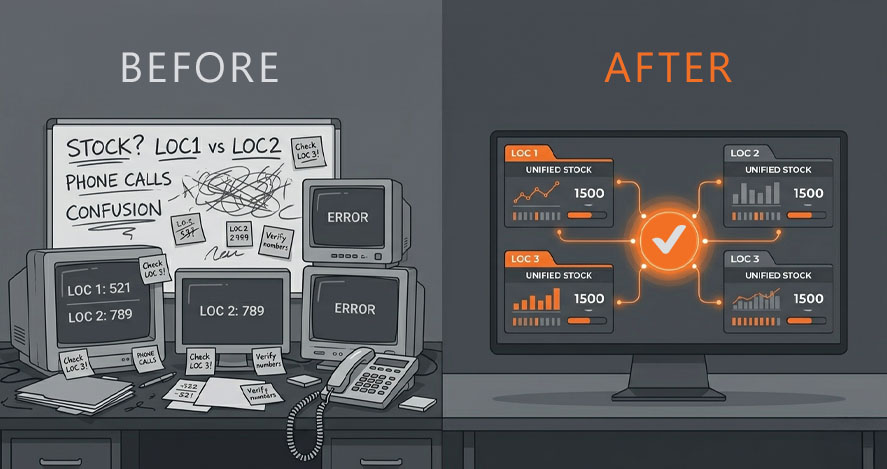
A unified multi warehouse inventory management system replaces every informal handoff with an automated, real-time process. Here’s what that looks like in practice for a distributor running stock across more than one site.
One Inventory Picture Across All Locations
Instead of each location maintaining its own count, every site feeds into a single inventory record. When stock moves, gets received, or gets transferred, it updates in real time across the whole system. A manager at Location A can see what Location B has on hand without making a call. A rep quoting availability is looking at the same numbers as the warehouse team. The inventory picture is the same for everyone, everywhere, at the same time.
Inter-Branch Transfer Tracking in Real Time
Transfers between locations become logged, trackable events with a clear record of what left, what arrived, and when. That means no more phantom units, no more missing stock at the receiving end, and no more manual reconciliation after the fact. When a unit leaves one location and arrives at another, both records update automatically. The audit trail is clean from the start.
Automatic Reconciliation Across Sites
Instead of a manual month-end process that takes days, reconciliation happens continuously. Every transaction across every location is recorded in the same system, so the books reflect reality in real time rather than whatever someone had time to compile last Friday. Finance gets numbers they can actually rely on, and the close gets faster because the data is already there.
QuickBooks Sync Across Every Location From a Single System
Every inventory movement across every location — receipts, transfers, adjustments, sales — flows into QuickBooks from one system rather than requiring separate entries from each site. For multi-location distributors, this eliminates the reconciliation gap that builds up when each location is syncing independently or not syncing at all. The result is a single, accurate financial picture that reflects what’s actually happening across the entire operation, not just what got entered before the deadline.
How to Know If You Need It
Not every distributor is at the same point operationally. But there are clear signals that your approach to multi warehouse inventory management has outgrown your current process.
You’re Managing Stock at More Than One Physical Site
This is the baseline. If stock lives in more than one location and those locations are being tracked separately, you have a problem whether it feels like one yet or not. The question isn’t whether you need a unified system — it’s how much the current gap is already costing you.
Inter-Branch Transfers Are Tracked Manually or Not at All
If moving stock between locations requires a phone call, a text, or a note in a spreadsheet to stay accurate, the transfer process is a liability. Every informal handoff is an opportunity for the books to drift from reality.
Month-End Reconciliation Requires Pulling Data From Multiple Systems
If closing the books at the end of the month means someone spending hours pulling numbers from different sources and assembling them by hand, the reconciliation process has already become a structural problem. The time cost is real, but the accuracy risk is bigger.
Your Team Can’t Answer “Where Is That SKU Right Now?” Without Making Calls
If a rep or manager can’t look up what’s available across all locations in under a minute, the visibility gap is already affecting customer service. Stock that exists but can’t be located fast enough is functionally the same as stock that doesn’t exist.
How Optimum Handles Multi Warehouse Inventory for Distributors
Optimum’s inventory visibility tools are built specifically for distributors managing stock across more than one location. Every site feeds into a single inventory record. Transfers between locations are logged as trackable events, not informal handoffs. Stock levels update in real time across the full operation, so every team member — regardless of which location they’re working from — is looking at the same numbers at the same time.
The system connects directly to your existing distribution management workflow, so adding a location doesn’t mean rebuilding your tracking process from scratch. It means extending the same unified system to cover the new site. And because every movement across every location flows into QuickBooks from a single source, the month-end close gets faster and the financial picture gets cleaner as the operation grows.
For distributors who are still early in evaluating whether a unified system makes sense, the question to ask is simple: how much time does your team currently spend every week reconciling location data that should already agree? That time has a dollar value. And the answer is almost always higher than people expect once you add up the hours across the ops team, the drivers handling transfers, and the finance team assembling month-end numbers by hand. A unified system converts that recurring cost into a one-time implementation investment. The operation runs cleaner, the books close faster, and the team stops spending their week chasing numbers that should already be in one place.
FAQ
What is multi warehouse inventory management?
Multi warehouse inventory management is the process of tracking, moving, and reconciling inventory across more than one physical location from a single unified system. For distributors, it means every warehouse, branch, or distribution point feeds into one real-time inventory picture instead of separate systems that have to be manually reconciled.
How do inter-branch transfers work in a multi warehouse system?
In a unified system, inter-branch transfers are logged as trackable events rather than informal handoffs. When stock moves from one location to another, both records update automatically — the sending location reflects the outbound transfer and the receiving location reflects the inbound receipt. The audit trail is clean from the moment the transfer happens.
How does multi warehouse inventory sync with QuickBooks?
In Optimum’s system, every inventory movement across every location flows into QuickBooks from a single source. For the full breakdown of how the QuickBooks integration works for distributors, see our post on distributor operations and QuickBooks sync.
What is the difference between multi warehouse and single location inventory management?
Single location inventory management tracks stock in one place. Multi warehouse inventory management tracks stock across multiple physical sites from one unified system, with the added complexity of inter-branch transfers, cross-location visibility, and reconciling books that span more than one operation. The jump from one to the other is where most distributors find their existing process starts to break down.
How do distributors reconcile inventory across multiple locations?
With a unified system, reconciliation happens continuously rather than as a manual month-end exercise. Every transaction across every location is recorded in the same system, so the books reflect real-time activity rather than whatever was compiled last. Without a unified system, reconciliation typically means pulling data from multiple sources by hand — a process that takes time, introduces errors, and produces numbers that are already out of date.
Multi warehouse inventory management isn’t a nice-to-have for distributors running more than one location — it’s the infrastructure that makes everything else work. When transfers are tracked, stock levels are accurate, and the books reconcile automatically, the operation runs the way it’s supposed to. The team stops chasing numbers and starts making decisions. That’s what a unified system actually delivers.
Watch Your First AI Workflow Come to Life
In this 15 minute 1-on-1 session, we will map out your most frustrating manual process and build a functional AI automation prototype right in front of you.